AdaEvolve
AdaEvolve: Adaptive LLM Driven Zeroth-Order Optimization
Abstract
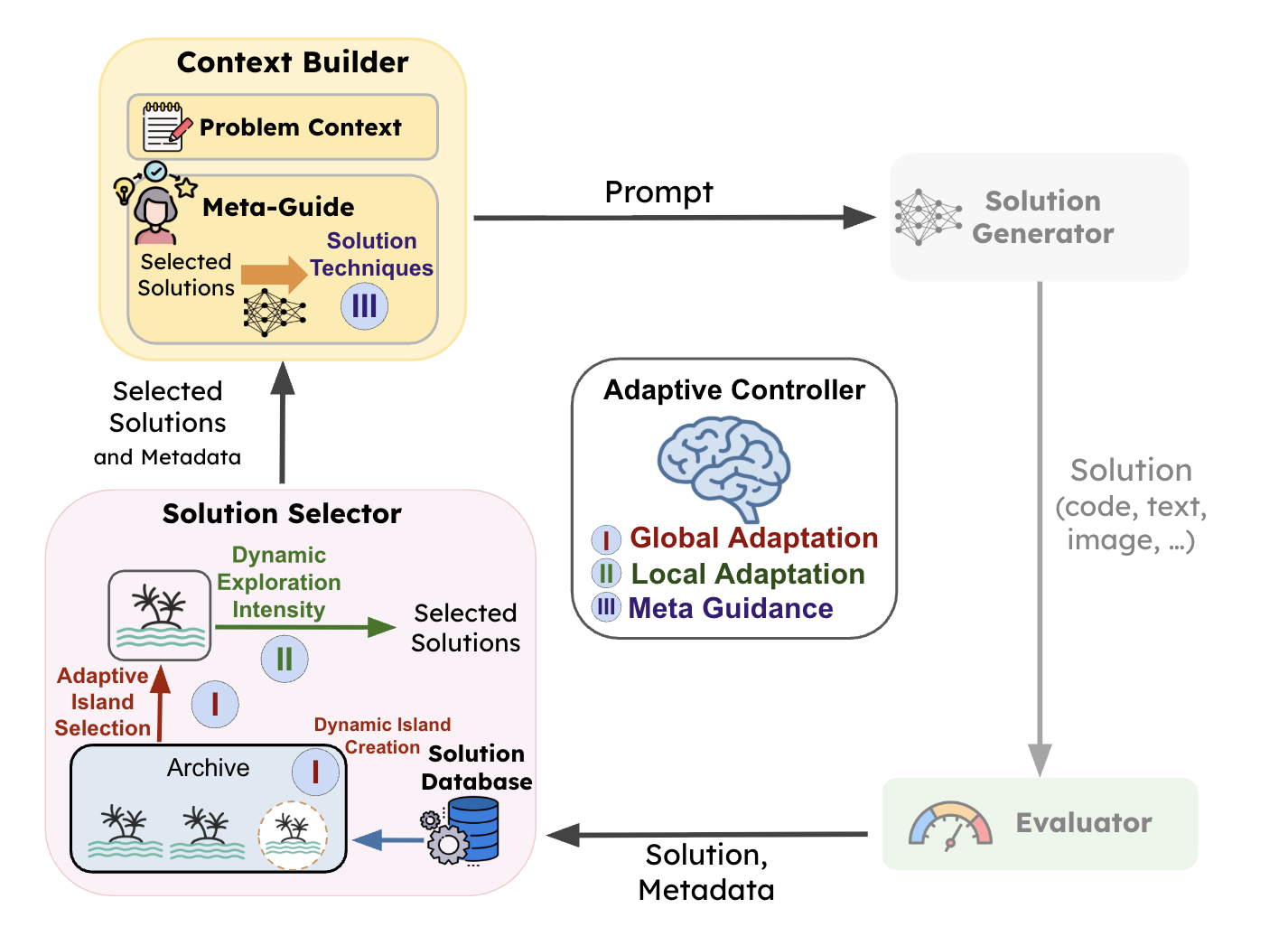
The paradigm of automated program generation is shifting from one-shot generation to inference-time search, where Large Language Models (LLMs) function as semantic mutation operators within evolutionary loops. While effective, these systems are currently governed by static schedules that fail to account for the non-stationary dynamics of the search process. This rigidity results in substantial computational waste, as resources are indiscriminately allocated to stagnating populations while promising frontiers remain under-exploited. We introduce AdaEvolve, a framework that reformulates LLM-driven evolution as a hierarchical adaptive optimization problem. AdaEvolve uses an “accumulated improvement signal” to unify decisions across three levels: Local Adaptation, which dynamically modulates the exploration intensity within a population of solution candidates; Global Adaptation, which routes the global resource budget via bandit-based scheduling across different solution candidate populations; and Meta-Guidance which generates novel solution tactics based on the previously generated solutions and their corresponding improvements when progress stalls. We demonstrate that AdaEvolve consistently outperforms the open-sourced baselines across 185 different open-ended optimization problems including combinatorial, systems optimization and algorithm design problems.
EvoX
EvoX: Meta-Evolution for Automated Discovery
Abstract
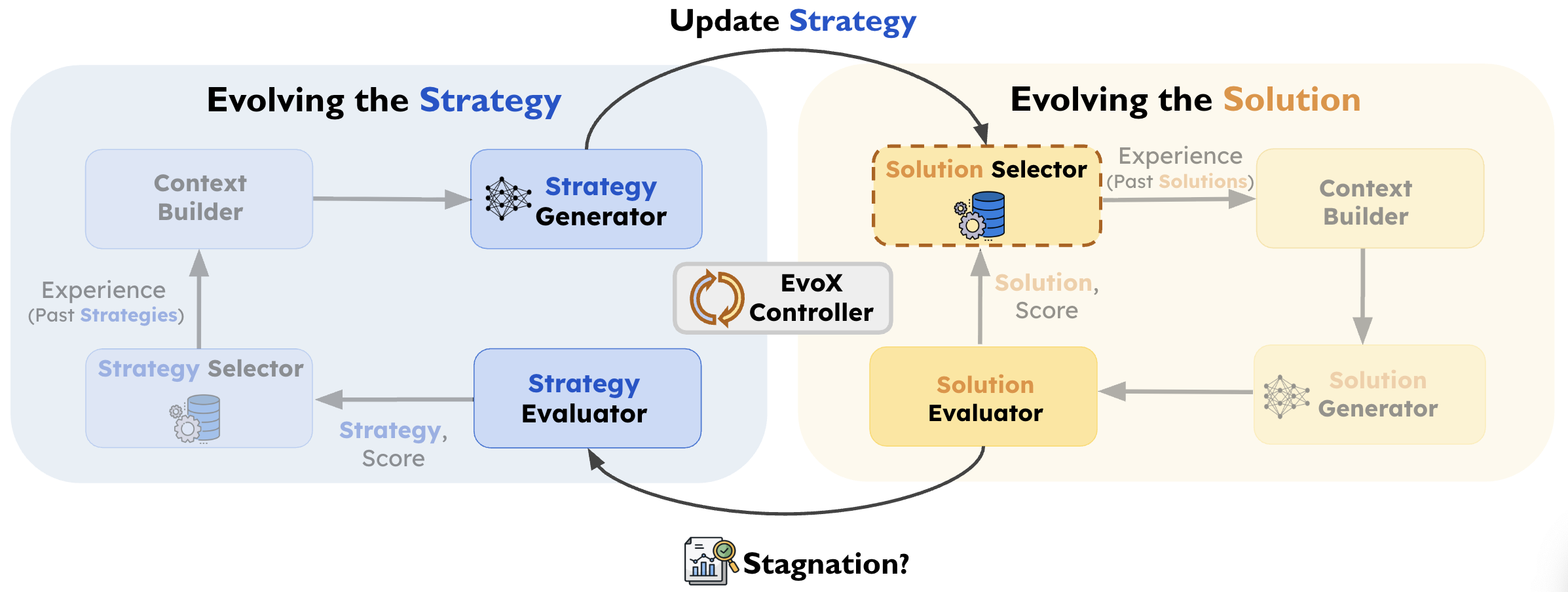
Recent work such as AlphaEvolve has shown that combining LLM-driven optimization with evolutionary search can effectively improve programs, prompts, and algorithms across domains. In this paradigm, previously evaluated solutions are reused to guide the model toward new candidate solutions. Crucially, the effectiveness of this evolution process depends on the search strategy: how prior solutions are selected and varied to generate new candidates. However, most existing methods rely on fixed search strategies with predefined knobs (e.g., explore–exploit ratios) that remain static throughout execution. We introduce EvoX, an adaptive evolution method that optimizes its own evolution process. EvoX jointly evolves candidate solutions and the search strategies used to generate them, continuously updating how prior solutions are selected and varied based on progress. Across nearly 200 real-world optimization tasks, EvoX outperforms existing AI-driven evolutionary methods including AlphaEvolve, OpenEvolve, GEPA, and ShinkaEvolve on the majority of tasks.